News & Announcements
Celebrating 15 years, St. Luke’s program brings power of music therapy to young patients

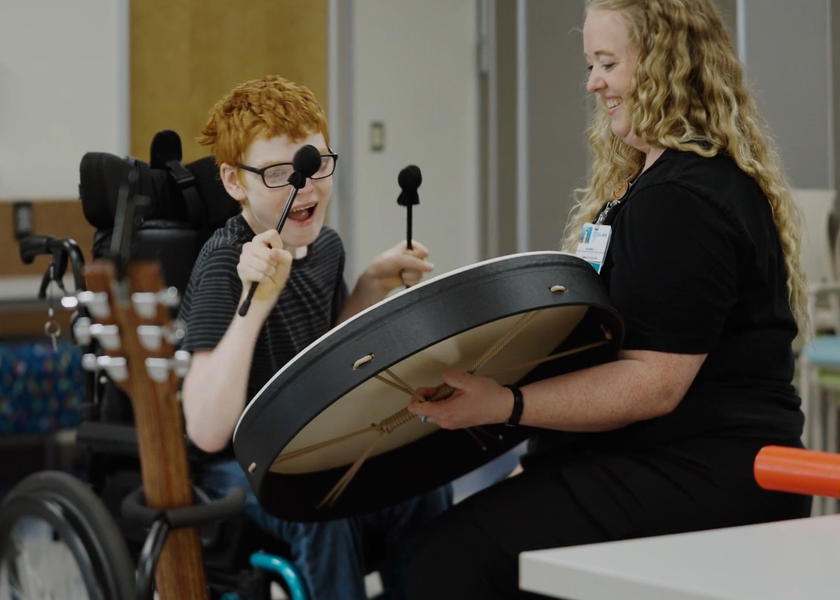
Kathrine Lee with a patient during music therapy.
By Chris LangrillLast Updated December 2, 2025
Most of us can remember – maybe even long for – the soothing sounds of a lullaby being sung to us when we were young.
On the most basic level, a unique program at St. Luke’s Children’s Hospital provides just that, helping young patients feel more comfortable via music therapy.
“Lullabies can be therapeutic, for sure,” said Kathrine Lee, a board-certified music therapist who has worked in the St. Luke’s music therapy program for the past four years. “As music therapists we’re using music in a targeted way. If we have a kiddo who needs rest, needs sleep or needs relaxation, we can use music meditation to help them rest and that can be in the form of a lullaby.”
Research clearly shows that music therapy can help children in medical settings manage pain and cope during procedures. It also provides support for their families.
“Our job is to use music to help with pain or anxiety, helping a kid just be a kid in a medical setting and letting them (use) instruments … letting them know it’s OK to make sound and give them a choice in a place where they don’t get to make a lot of choices,” Lee said. “It can give some of their autonomy back.”
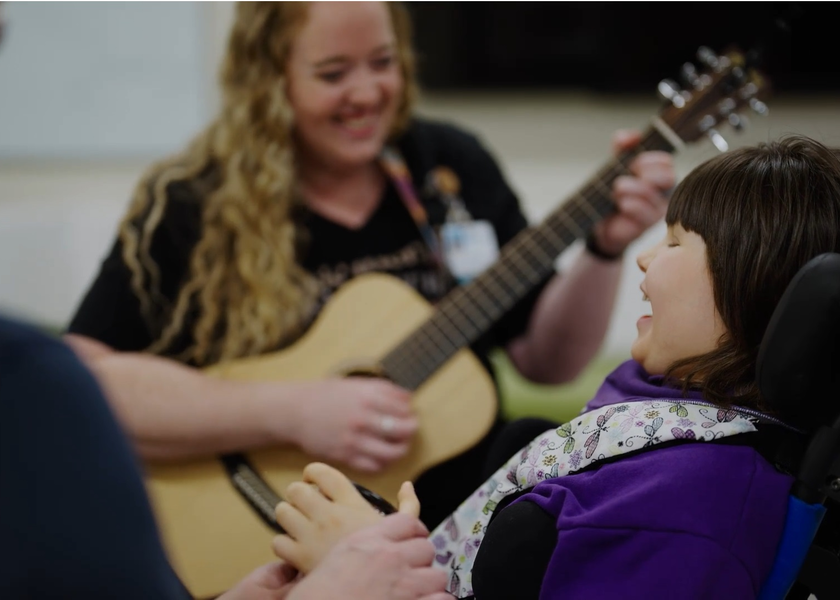
Kathrine Lee, playing a guitar with patients.
Children at St. Luke’s might experience music therapy in any number of ways.
“We might do active music together or we might listen to songs and do songwriting,” Lee said. “Sometimes there’s family engagement and lyric poetry, recordings, all kinds of stuff. It’s really tailored to each kid and each session, depending on what they need in those moments.”
Lee grew up singing in a choir. As part of her board competency, she has to be clinically proficient in voice, piano, guitar and percussion. At the hospital, she and the patients use the ukelele quite a bit, as it’s an easy to learn instrument.
Regularly working with children who are developmentally delayed, she often witnesses the power of music when working with those kids.
“With music, we can say a whole lot of things without saying a word,” Lee said. “We can bang a drum and communicate very clearly how we feel. We can dance and move and communicate how we’re feeling. So, being verbal is not a requirement for all these kiddos. They communicate a lot through music.”
Whitney Price is a social worker and clinical supervisor in St. Luke’s Children’s Palliative and Supportive Care program. She has worked alongside Lee, often impressed by the impact as she works with children.
“She’s so mindful when she’s in the room with co-treatment, so she might be working with a physical therapist or an occupational therapist,” Price said. “Let’s say they’re working on right-side arm movement. She’ll go over there and place an instrument where that kid has to work that muscle, that arm.