Patient Stories
Even remotely, St. Luke’s supervisor helps save team member’s life after stroke
By Dave SouthornLast Updated December 22, 2025
At St. Luke’s, the word “care” can mean so many things, from hospitals and clinics to the well-being of communities at large.
It also means looking out for one another, even miles apart.
That took on a special meaning Sept. 18 for two St. Luke’s pharmacy team members, when a bond spurred life-saving action despite not seeing one another face-to-face.
Monica Lopez, a medication access team leader, noticed that Mandy Thueson, an education trainer and “jack of all trades” on the infusion authorization team, had left a meeting but her camera remained on.
After getting no response, she eventually contacted Thueson’s husband, Jason, who found her on the floor. She had suffered a stroke.
“Monica is amazing,” Thueson said. “If she hadn’t called Jason, I can’t really think about what would’ve happened, the outcome could’ve been a lot different. Some of the doctors I saw said I probably wouldn’t be here if not for what she did.”
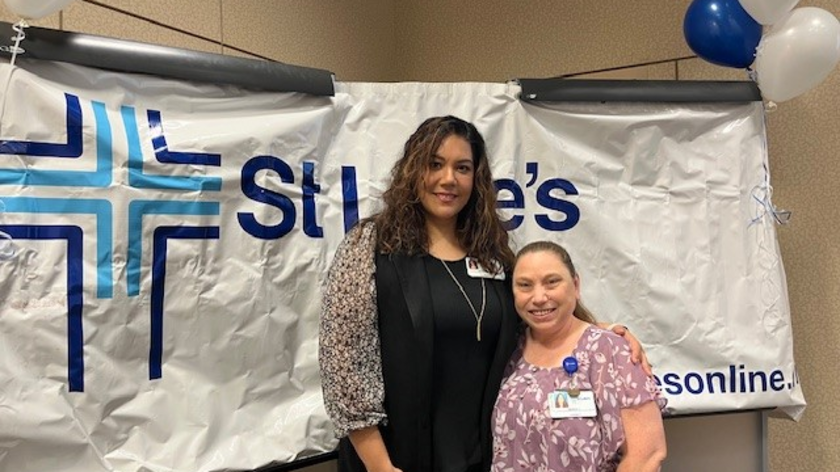
Monica, a medication access team leader and Mandy, an education trainer.
Thueson has worked for 16 years at St. Luke’s and has been a major part of the team Lopez helps oversee.
“Whenever I need to get out of my head … if there’s some big change, I go to her, she’ll always tell me, ‘We’ll get through it, we will be fine, we always do, we’re a team,’” Lopez said. “She’s always that peacemaker, a calming presence, always steps up to help.”
And Lopez returned that team-first mindset and willingness to help on that fateful day.
During a weekly team huddle on Microsoft Teams, a day in which most of the team was working remotely, Thueson was set to present early. But, in a twist of irony, there were many “safety moments” the dozen or so people on the meeting wanted to discuss, so Thueson wanted to make way for that discussion.
By the time it was her turn to present, Thueson wasn’t there. Her camera was on, but there was no one to see. Lopez messaged her, then tried her cell phone. Nothing.
“That was unlike her, so I started to get a little worried, but at the same time, what if something came up, and she just didn’t have the time to let me know?” Lopez said.
After trying a few more times, she pulled up Thueson’s emergency contact, Jason. He was there at home with Mandy, but he worked nights, so he was asleep upstairs.