Patient Care
St. Luke’s Children’s mobile care program expands into more districts this school year

St. Luke’s primary care manager Abby Goade, right in first group, poses with one of St. Luke’s Children’s Mobile Care units at Berkeley Building Company in Meridian. Berkeley is one of the unit’s sponsors.
By Chris LangrillLast Updated August 29, 2025
It seems like such a simple concept: If people can’t come to you, then you go to them.
When it comes to health care, that can be easier said than done. For young patients, additional hurdles exist as they cannot schedule their own appointments, have parents are busy working or don’t have transportation.
But St. Luke’s has a dedicated team seeking to address those issues and are expanding their reach across the region with St. Luke’s Children’s Mobile Care.
Launched at the start of the 2021-22 school year, the program has served the Boise and Nampa school districts with the aim of bringing health care to kids who might not have access to traditional care.
This school year, St. Luke’s has entered into agreements with Caldwell and Mountain Home to begin serving children in those school districts.
“It’s been fantastic,” said Keri Harris-Noll, director of operations at St. Luke’s Children’s Hospital. “A lot of these kids don’t have the same access to health care that some other kids do, so we’re taking health care to them.”
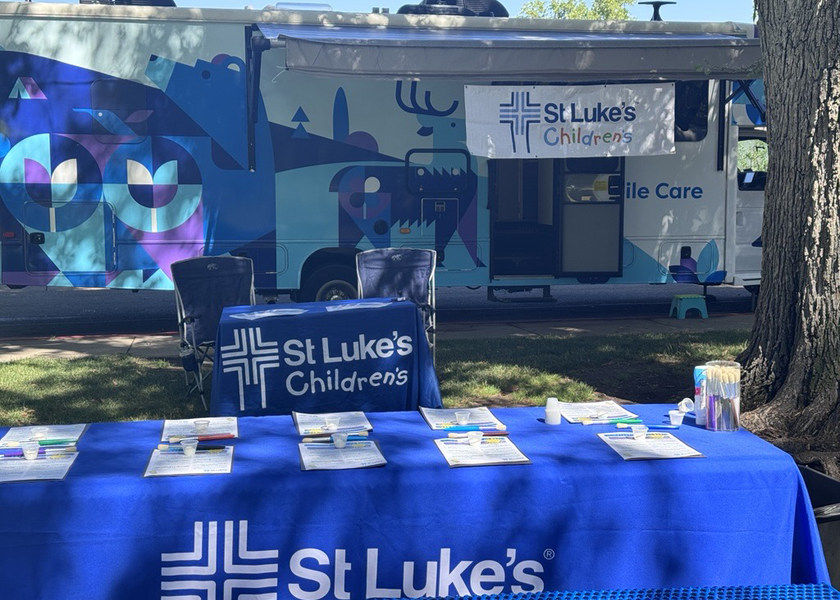
St. Luke’s Children’s setup, including one of the mobile care units, at a community event this summer in Caldwell.
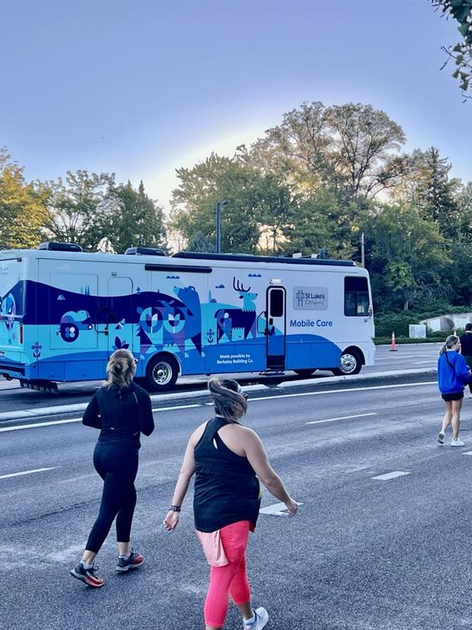
Still, it’s been quite an undertaking. St. Luke’s utilizes two mobile units - Bandit and Bluey - that have been outfitted to mimic a pediatric office.
“Research shows that kids who stay in school have better health outcomes,” Harris-Noll said. “So, I would say we really target those populations where the kids are underinsured or uninsured … or where there is a large percentage of homelessness.
“A lot of these kids don’t have the same access to health care that some other kids do, so we’re taking the health care to them. … That can help keep them in school.”
Dr. Noreen Womack, a St. Luke’s pediatrician, has been involved with the program since its inception. As such, she’s seen firsthand the difference the mobile clinics can make.
“I’m so proud that St. Luke’s does this,” Dr. Womack said. “It works, and it helps. … It’s a way to reach these families that otherwise wouldn’t be reached. We’ve seen kids who have had significant medical illnesses and we’ve been able to connect them with specialists.”
In fact, Dr. Womack said helping families navigate the health care system has taken on a larger role than what she had originally envisioned.
“When we first conceived this we thought, ‘Oh, we’ll see strep and ear infections, etc.,’” she said. “And we do that. But what we really do is help those kids who haven’t had any kind of medical care in years. … So, we work with school staffs to find those kids who have fallen through the cracks, through no fault of their parents, and we try to connect them with a primary care provider.”