News & Announcements
‘Serving the underserved’: How a St. Luke’s nurse educator embraced a new role and affected change

St. Luke’s team members gathered and celebrated Vibecke Thompson in early May. Among those pictured with her are director of clinical learning Julie Zeigler to the left of Thompson, and Thompson’s husband Brett, to the right.
By Dave SouthornLast Updated May 29, 2026
When aptitude and opportunity meet, special things can happen.
For Vibecke Thompson, what happened in that scenario was the creation of a passion that has now become part of the fabric of St. Luke’s care.
A clinical educator at St. Luke’s Canyon View Behavioral Health Services in Twin Falls, Thompson spent nearly 20 years as a nurse and professor before moving into her current role in 2020. She did not have much background in mental health, but it proved to be a perfect fit.
“I always had an interest … but it wasn’t until I started that I really found that passion and started to understand how important it is to overall health, its impact,” Thompson said.1e
At St. Luke’s 2026 Nursing Excellence Awards in May, Thompson earned the top honor for Exemplary Professional Practice (Hospital). It was fitting to have taken place during National Nurses Month and Mental Health Awareness Month.
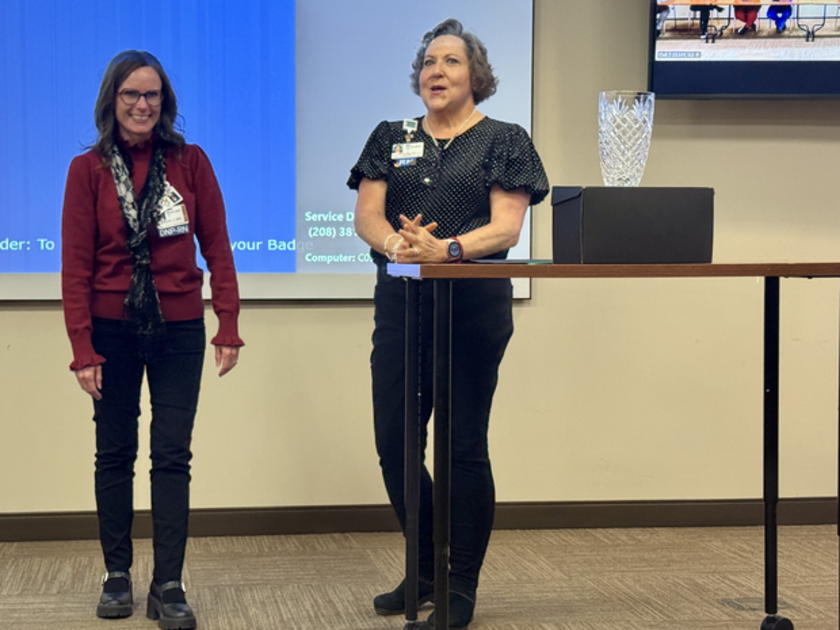
Vibecke Thompson, left, listens as St. Luke’s Center for Nursing Excellence director Robyn Beall presents her award.
“She has an unbelievable commitment to serving the underserved,” said Julie Zeigler, director of clinical learning at St. Luke’s Magic Valley. “She’s been integral in partnering to develop behavioral response teams … and she’s strengthened our knowledge inside the health system and outside of it.”
After 10 years as a labor and delivery nurse at St. Luke’s Jerome, Thompson began her Canyon View role at the outset of the COVID-19 pandemic.
Very quickly, she saw a growing need.
Beyond de-escalation techniques for aggressive behavior, she was fascinated about the “why.” Soon, she began working on her doctorate and was fascinated by trauma-informed care.
The concept is still young, as the Substance Abuse and Mental Health Services Administration published its first guidance on its implementation in 2014.
“It doesn’t take much, it’s rethinking ‘what’s wrong with you?’ into ‘what happened to you?’” Thompson said. “Your rational brain isn’t always in control. Behavior can be part of a trauma someone had a long time ago. If patients had this 10, 20 years ago, would they even be coming in today?”
Now, trauma-informed care touches all corners of healthcare at St. Luke’s. And even beyond.
Thompson herself has traveled to St. Luke’s sites to present to teams from the ICU to emergency departments to rehab units, but also has been asked by groups like the Twin Falls Public Library to provide guidance.